

The LED Triac Dimming Principle
The triac commonly referred to as a triac, is a large-power semiconductor device with a four-layer structure consisting of three PN junctions. It is generally formed by the reverse connection of two triac. The triac not only serves as a rectifier but can also function as a fast switch for making or breaking connections without physical contact; it can invert DC to AC; and it can convert one frequency of AC to another frequency. Like other semiconductor devices, triac offer advantages such as small size, high efficiency, good stability, and reliable operation.
There are three main types of triac based on their appearance: spiral type, flat type, and flat-bottom type, with the spiral type being the most commonly used.
The triac has three terminals: the anode (A), the cathode (C), and the gate (G). The chip is composed of a four-layer structure of P-type and N-type conductors, forming three PN junctions, which is distinct from the structure of a silicon rectifier diode that only has one PN junction. The four-layer structure and the introduction of the gate terminal enable the triac to exhibit its remarkable "small control large" feature, which is fundamental to its operation.
When an triac is used, applying a small current or voltage to the gate terminal can control large currents or voltages between the anode and cathode. triac can be manufactured to handle currents ranging from several hundred amperes to over a thousand amperes. triac with a current rating of 5 amperes or less are referred to as small-power triac, while those rated above 50 amperes are considered large-power triac.
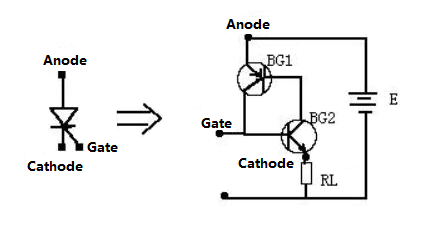
If we examine the first, second, and third layers from the cathode, we can see that the triac behaves like an NPN transistor, while the second, third, and fourth layers form a PNP transistor. The second and third layers overlap and are shared between the two transistors. An equivalent circuit diagram can be drawn to represent this. When a positive voltage is applied between the anode and cathode (E), and a positive trigger signal is applied between the gate (G) and the cathode (C), the base-emitter junction of the second transistor (BG2) is forward-biased, causing a base current (Ib2). This current is amplified by the transistor, and BG2 generates a collector current (IC2) which is amplified by the first transistor (BG1) to provide a feedback loop. The current from BG2 is fed back into the base of BG1, and the process continues, amplifying the current until both BG1 and BG2 are fully conducting. This is known as latching or triggering of the triac, where a small trigger current causes the SCR to immediately turn on. The turn-on time mainly depends on the triac characteristics.
Once the triac is triggered on, due to the feedback loop, the current flowing into the base of BG2 is no longer just the initial Ib2, but a much larger current that has been amplified by both BG1 and BG2 (β1 * β2 * Ib2). This current is sufficient to keep BG2 conducting. At this point, even if the trigger signal disappears, the triac remains in the conducting state. The triac will only turn off when the power supply voltage (E) is disconnected, or when the voltage decreases to the point where the collector currents of BG1 and BG2 are no longer large enough to sustain conduction. If the polarity of the voltage (E) is reversed, the triac will be in a non-conducting state. In this case, the triac will not respond to trigger signals. Additionally, if there is no trigger signal but the forward anode voltage exceeds a certain threshold, the triac may also turn on, though this is considered abnormal operation.
The triac ability to be triggered on with a small control signal (trigger current) to control large currents is the key feature that distinguishes it from regular silicon rectifier diodes.