
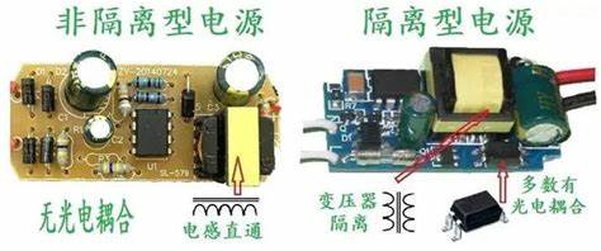
Mainly from the following aspects:
Safety
Isolated power supplies use transformers to reduce the 220V voltage to a lower voltage through transformers, and then rectify it into DC output for power supply. Because the primary coil of the transformer bears 220V voltage, the secondary coil only bears the output low AC voltage, and the primary and secondary coils are not directly connected, it is called an isolated power supply. The conversion process of the transformer is: electric-magnetic-electric, and there is no connection to the earth, so there is no risk of electric shock.
The non-isolated power supply is directly input to the electronic circuit with 220V, and then outputs the voltage through electronic components. The input and output are directly connected through electronic components, so it is called a non-isolated power supply; the difference between the two is the presence or absence of a transformer. LED non-isolated design is limited to double-insulated products, such as bulb replacement products, in which the LED and the entire product are integrated and sealed in non-conductive plastic, so the end user does not have any risk of electric shock. Secondary products are all isolated and relatively expensive. Non-isolated circuits are input power directly added to the LED load after bucking, and there is a risk of electric shock.
Therefore, if you want to pass safety certification, such as 3C, UL, CE, etc., non-isolation is troublesome. Generally, manufacturers do not have absolute design and technical strength, and it is generally difficult to pass. Because the insulation and creepage distance are not enough, you can only design from the physical structure of the lamp. The lamp tube is acceptable, and there are also full plastic ones. For example, the insulation between the LED and the aluminum heat sink usually relies on the film insulation of the printed circuit board of the aluminum substrate. Although this insulation layer can withstand 2000V high voltage, sometimes the burrs of the screw holes will produce the so-called creepage phenomenon, making it difficult to pass the CE certification.
However, as a complete LED lighting product, the part of the product surface that the user can touch must be isolated to prevent people from getting electric shock. From the perspective of the entire product system, isolation is inevitable, and the only difference is the location of the isolation. As a product that can be used safely by end users, the reliability of insulation and isolation must be considered.
Note: It should be reminded that some manufacturers use the method of directly tapping the main coil to extract low voltage in order to save costs. This method seems to have a transformer, but there is actually no secondary coil, so it cannot be considered an isolated power supply!
Electrical performance
In terms of performance, the advantages of isolated power supply are: it will not pose a threat to the human body, and the wide voltage performance is very good. Non-isolated power supply is also very mature now, and the voltage range is slightly worse than that of isolated power supply, which is between 110V-300V; while isolated power supply can achieve 60-300V. High and low currents are very uniform. Isolated drive is safe but less efficient, while non-isolated drive is more efficient. Whether isolated or non-isolated drive should be selected according to actual use requirements.
In terms of constant current accuracy: isolated type can be within ±5%, while non-isolated type is difficult to achieve.
Non-isolated circuits are very sensitive to surges and have poor suppression capabilities. Lightning surge, this voltage is instantaneous high voltage, up to several thousand volts, very short time, extremely strong energy, this voltage enters the power supply, for the non-isolated BUCK circuit, it will be instantly transmitted to the output, damage the constant current detection loop, or further damage the chip, causing 300v direct pass, and burning the entire lamp tube. In fact, it refers to non-isolated power supplies. When shipped in batches, the return rate is higher than that of isolated LED driver power supplies, mostly because of explosion. The probability of explosion of isolated power supplies is much smaller, and non-isolated ones are generally around 2% to 3%.
Many power grids have unstable voltages, and isolation will also occur. The phenomenon is that the chip, MOS tube, and constant current loop are all burned out, but isolation is relatively much less.
Note: Therefore, non-isolated surge protection varistors are indispensable, and those without varistors are all empty talk.
Cost and efficiency
The cost of electronic products is not only the design and production cost, but also the maintenance cost of large-volume products. As for the circuit structure of LED power supply, the current isolation scheme is mostly AC/DC flyback circuit scheme, so the circuit is relatively complex and the cost is relatively high. The non-isolated type basically adopts DC/DC boost or buck circuit, which is relatively simple, so the cost is relatively low.
Because of the lack of energy loss of transformer, the efficiency of non-isolation can generally reach more than 90%, and it has a higher power factor. The energy efficiency of isolation is generally 88%, depending on the power, so the heat of isolated power supply is also relatively large.
Non-isolated power supply has advantages over isolated power supply in efficiency and cost. It is not easy to make the efficiency of isolated power supply high. If it is not handled well, it will generate a lot of heat and high cost, especially for LED fluorescent lamps with built-in lamps. However, non-isolated power supply has poor ability to suppress lightning surge voltage, so it will encounter a lot of damage when shipped in large quantities.
Compared with isolated power supply, non-isolated power supply mainly reduces transformers, designs the architecture with the least materials, and achieves the same product functions, so non-isolated cost has a greater advantage. This is probably why non-isolated power supplies are so popular in China.
Note: In low-voltage LED lamps, non-isolated solutions are the best choice based on the principle of efficiency and cost priority.
Occasions of use
Whether to use an isolated insulation transformer or an isolated protective lampshade housing usually requires analysis from many aspects, such as cost and manufacturing process, efficiency and volume, insulation reliability and safety regulations. Both types of designs will continue to be used because each design meets different market needs.
In terms of load range, generally speaking, the output load range of isolated power supplies is 30-42V, and the non-isolated load range can be 30-84V. When selecting power supplies, many LED manufacturers require that the power supply can adapt to the full voltage 90-265V input for overall adaptability, and the load range is also required to be as high as 84V. Such a choice has certain risks and hidden dangers. When the input is 90V, the power supply may lose the constant current function, THD, etc. Non-isolation is suitable for high voltage and small current, and the cost of large current is not cheaper than isolation.
Non-isolated power supplies are suitable for occasions: first, indoor lamps. This kind of indoor power environment is better, and the surge impact is small. Straw hats and SMD LEDs are used in high voltage and low current. It is meaningless to use non-isolated for low voltage and high current, because the efficiency of low voltage and high current non-isolated is not higher than that of isolation, and the cost is not much lower. It is not suitable for centralized lighting. What is centralized lighting? That is, hundreds of lamps are turned on on the same AC line. At this time, because there are too many lamps on one line, the voltage environment on this line is dirty, so the probability of damaging the lamps increases, so non-isolated power supplies are used for LED lamps.
From the perspective of the entire product system, isolation is inevitable, the only difference is the location of the isolation. Some designers use isolated transformer design, so they can simplify the design of heat dissipation and lampshade (how to simplify the design of heat dissipation? The lower the efficiency of isolation, the greater the heat. It is just to simplify the isolation design of lamps, right?). If a non-isolated drive design is used, reliable insulation requirements must be considered in the structure of the lamp shell.
Note: As a power drive, isolation and non-isolation solutions have always existed at the same time.
Due to the above points, these two types of power supplies have their own advantages. Non-isolated power supplies focus on higher power factor and efficiency, reducing energy loss; while isolated power supplies focus on life safety and the overall safety of fluorescent lamps, and are slightly inferior to non-isolated power supplies in terms of power factor and efficiency. There are no rigid regulations for different power supply types in different occasions and different usage environments.