
Liquid Electrolytic Capacitor vs Solid State Capacitor Life Comparison
To evaluate whether the life of a power supply can exceed the warranty period of the specification, the main focus is on the life of the output capacitors. Currently, there are two types of capacitors commonly used in the industry, one is liquid electrolytic capacitors and the other is solid state capacitors. As for which one to choose, it is necessary to first understand the nature of these two types of capacitors.
Table 1 is a comparison of liquid electrolytic capacitors and solid state capacitors. Liquid electrolytic capacitors are widely used in rectification, filtering circuits due to large capacity, low price and other characteristics, but its heat will accelerate the consumption of electrolyte to dry up, and even cause the electrolyte to boil and burst the top; at the same time, the drying up of the electrolyte will also reduce the ripple current withstand capacity, drastically shorten the service life of the capacitor, but also increase the leakage current, loss increases, resulting in transient over-temperature and other hazards. Therefore, heat is the use of electrolytic capacitors can not be ignored factors in the use of electrolytic capacitors should ensure that electrolytic capacitors should not exceed its rated operating temperature, try to avoid heat sources, when necessary, the use of effective measures for cooling.
Solid capacitors, is in addition to tantalum capacitors, the highest capacitance, using highly conductive molecular materials, inside the powdered electrolyte, with explosion-proof pulp, good stability, high reliability, high temperature resistance, long life and other advantages. The main role of solid-state capacitors is to further filter some of the current spikes and stray waves, can ensure the stability of the power supply in all parts. Motherboard in the process of long-term use of overheating leads to thermal expansion of the electrolyte, when heated to more than the boiling point, electrolytic capacitors will produce pulp phenomenon, commonly known as the motherboard pulp, the more high-end motherboards will be used in solid-state capacitors to avoid this situation.
|
Abbreviations |
Liquid Electrolytic Capacitors |
|
|
Full name |
Liquid Aluminium Electrolytic Capacitors |
Conductive Polymer Aluminium Solid State Capacitors |
|
Dielectric Materials |
Electrolyte |
Conductive polymers PEDT |
|
Appearance |
Aluminium case mostly covered with plastic film, with explosion-proof wires on the top (as shown in Figure 1) |
Aluminium case with specifications printed on the top, mostly without explosion-proof wires (as shown in Figure 2) |
|
Temperature Characteristics |
Low temperature: electrolyte solidification High temperature: electrolyte expansion, high-pressure explosion |
High and low temperature stabilization |
|
Cost |
Low |
High |
|
volumetric |
Large |
small |
|
Impedance |
Large |
small |
|
Operating Frequency |
Applicable Low Frequency |
Applicable high frequency |
|
Applications |
Consumer electronics, industrial applications, information electronics, communication brands, computers, high-end servers, IPC, motherboard CPUs, automotive and other markets. |
Mainly used in: Circuit breaker type power meter, MDL Power Logger, camera, LED advertising Peripheral, LCD TV, graphic cards, game consoles, telecom (base station, router, netcom) high-level products or high temperature places. |
Table I Comparison of Liquid Electrolytic Capacitors and Solid State Capacit
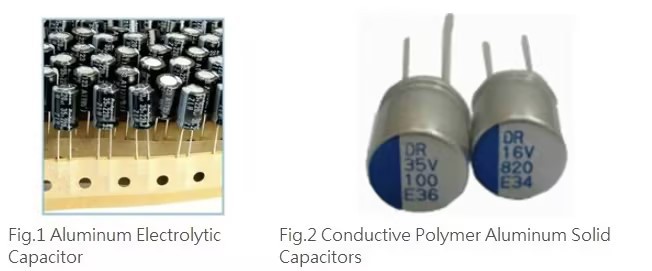
Table II shows the life comparison between the two. Compare the liquid electrolytic capacitor of 6000hrs/105℃ with the solid state capacitor of 5000hrs/105℃, Figure 3 is the life time under different temperatures calculated according to the formula; from the curve, we can know that under high temperature, the solid state capacitor doesn’t show high life time qualities, and under 90℃, the more obvious this quality will be.
|
Liquid Electrolytic Capacitors |
Solid State Capacitors |
|
Simple Law:Temperature drop every 10 ℃, life time doubled |
Simple law: temperature every 20 ℃, life increased by 10 times |
|
Formula:L=L0x2(Tmax-T) /10 LO: Capacitor Tmax life (specification value) T:The actual measured temperature of the capacitor |
Formula:L=L0x10(Tmax-T) /20 LO: Life of capacitor Tmax (specification value) T:Actual measured temperature of the capacitor |
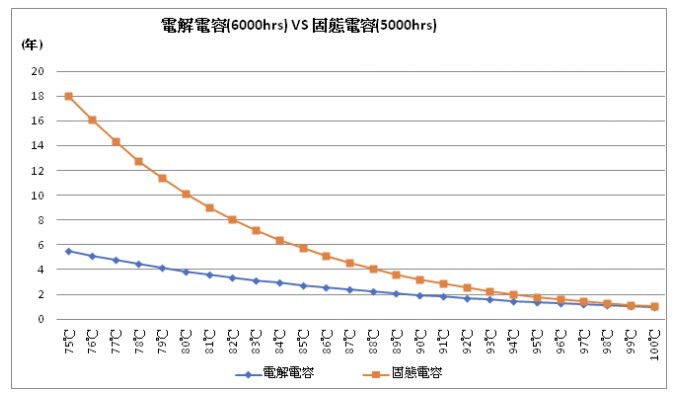
Figure 3 Comparison of Life Cycle
Although solid state capacitors have great advantages over liquid electrolytic capacitors, but considering the cost and fewer options for high withstand voltage capacitors, designers will only use solid state capacitors for some miniaturized or highly reliable products according to test results, so as to achieve product miniaturization and high life expectancy requirements, and the use of solid state capacitors does not necessarily have an absolute advantage in product life. The important thing is that the user must choose the right product according to the actual temperature and life time requirements. For product life evaluation, please refer to the product test report.