
Recently, “quality gates” have appeared frequently in LED products. In the quality inspection of Shanghai lamps in mid-July, 13 batches of products were found to be unqualified. Among them, well-known brands such as Osram and Opple also appeared on the blacklist; in late July, Changfang Lighting conducted a nationwide recall of the problematic 3W candle lamps and destroyed them in public; in mid-August, Sherlett was caught in a “quality gate” and disputes continued; at the end of August, the Guangdong Provincial Bureau of Quality and Technical Supervision recently announced Regarding the random inspection results of LED lighting products, the reporter found that among the 23 batches of LED light products randomly inspected, the failure rate was as high as 73.9%. The quality of LED products has always been criticized, and the quality scandals that have been staged in this round have made it worse.
Recently, I brought back two LED bulbs from Taiwan. It is said that these are two brands that are very popular in Taiwan and have a certain reputation, namely Delta (10W) and Everlight (8W). After the author dismantled and tested it, the results were equally disappointing.
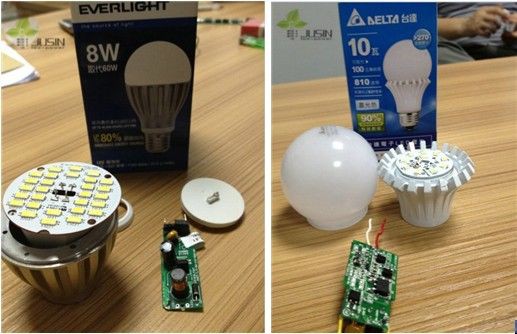
After lighting for 2 hours at room temperature, the temperature probe was used to measure the outer shell temperature, which was close to 80°C. Because disassembly is destructive, the internal ambient temperature cannot be restored and tested, but based on experience, the internal ambient temperature is at least 100°C. The author has done a similar experiment. I bought a bulb lamp kit at SEG Plaza, and then connected it to a 7W power supply. I used a temperature probe to test and found that the outer shell temperature was 76°C, the internal temperature was 93°C, and the transformer core temperature was 119°C. The electrolytic capacitor temperature is 112°C.
But what’s even more surprising is that after the bulbs are disassembled, both brands use non-isolated power supplies! Just ask: How safe is such a bulb? (But both products have 110V input. So, With the glue and plastic jacket, it may be able to pass high pressure, but the impact resistance and anti-interference ability can be imagined). Of course, these two major manufacturers have relatively good control over the materials they use, and they have chosen the electrolytic capacitors that affect their lifespan well. Delta uses two Manyu capacitors (10UF/400V, 22UF/100V); Everlight uses rubies. One capacitor (BXC series). Delta’s nominal warranty is two years, and Everlight’s nominal lifespan is 40,000 hours.
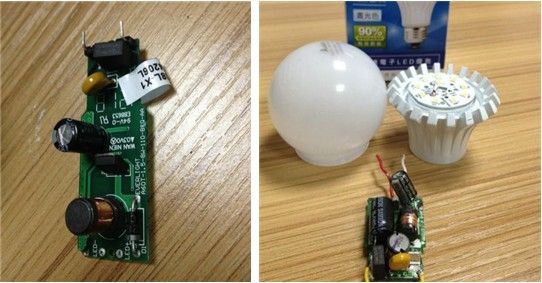
But what is puzzling is: Everlight’s power supply does not have an EMC device. Can such an ambient temperature life guarantee the nominal life? We can do the math. Electrolytic capacitors have different life spans depending on the brand. The life of inferior capacitors Only 2000-3000 hours, long-life brand capacitors can last 7000-10000 hours. This lifespan ultimately depends on its working environment. Of course, current ripple will also have an impact on lifespan, mainly temperature. And it is usually specified as the life at an ambient temperature of 105°C. Simply put, if the ambient temperature is higher than 105°C, then its life will be lower than the nominal life. If the ambient temperature is lower than 105°C, then its life will be lower than the nominal life. The service life is higher than the nominal life. There is a simple and easy-to-calculate relationship, that is, for every 10°C increase in ambient temperature, the lifespan is reduced by half; conversely, for every 10°C decrease in ambient temperature, the lifespan is doubled. Although this is just a simple estimate, it is also quite accurate.
Assuming that the internal temperature of the bulbs of these two famous companies is 100°C, the temperature of the electrolytic capacitor plus the temperature rise is at least 110°C, which has exceeded the specified 105°C. Its lifespan is at least 20% off, and the actual estimated lifespan is only It can last about 5,000 hours! So, where do the 2 years and 40,000 hours of life come from?
The products made by famous companies are just like this, and their lifespan is very high, let alone the following small businesses?
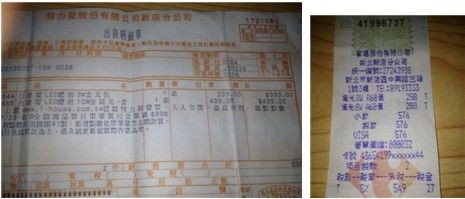
Finally reveal the price. Converted into RMB, Everlight’s 8W LED bulb is 61.1 yuan, and Delta’s 10W LED bulb is 105.9 yuan.
The above is just a simple analysis from the perspective of power supply, temperature, and lifespan, and is not brand specific. I just put a perspective on a very common market phenomenon to arouse the industry’s vigilance: the majority of LED companies must be able to really work hard on quality and let LEDs truly take advantage of long life, so that this industry can go higher and further. Chinese people must strengthen their quality and brand awareness and jointly safeguard the results of brand building.