
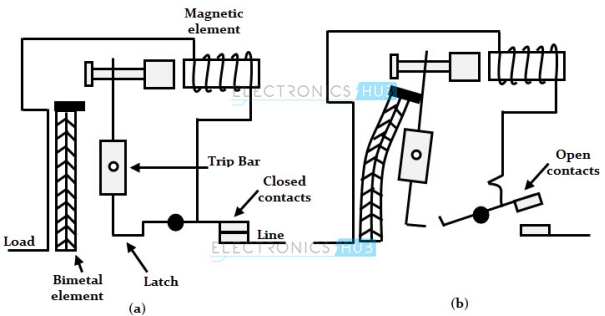
1. Basic concept: Miniature circuit breaker (MCB) is an electromagnetic device used to automatically disconnect the circuit when the current flowing through it exceeds the set value. If necessary, the MCB can also be opened and closed like a normal switch. These devices are rated for 220 volts for DC power supply and 240/415 volts for AC power supply, including different short-circuit current capabilities. Miniature circuit breakers perform various functions, such as local control switches, overload protection devices for specific appliances or equipment, and isolation switches to prevent errors. Miniature circuit breaker principle
The figure is shown below:
2. Circuit breaker type:
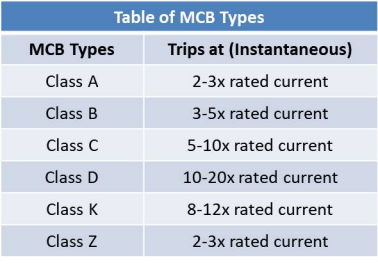
Circuit breakers generally have four tripping characteristics, namely A, B, C, and D:
Type A circuit breaker: 2 times the rated current, rarely used, generally used for semiconductor protection (generally using fuses)
Type B circuit breaker: 2-3 times the rated current, generally used for pure resistive loads and low-voltage lighting circuits, often used in household distribution boxes to protect household appliances and personal safety, currently less used.
Type C circuit breaker: 5-10 times the rated current, needs to trip within 0.1s, circuit breakers with this characteristic are most commonly used to protect distribution lines and lighting lines with large connection currents.
Type D circuit breaker: 10-20 times the rated current, mainly used in electrical environments with large instantaneous current, and less used in general households. Suitable for systems with large inductive loads and large impact currents, and often used to protect equipment with large impact currents.
The so-called multiple current: is the impact current resistance. The switch does not trip within a certain period of time. Its characteristic is to avoid impact current.
Low-voltage circuit breaker disconnection type selection: The circuit breaker disconnection types include overcurrent disconnection, undervoltage disconnection, parallel disconnection, etc.
Overcurrent release: It can be divided into overload release and short-circuit current release, with long delay, short delay and instantaneous, and overcurrent release is the most commonly used.
The setting value of the overcurrent release action current can be fixed or adjustable, usually adjusted by rotating or adjusting rod. There are two electromagnetic overcurrent release methods: fixed and adjustable. Electronic overcurrent release is usually adjustable.
The breaking capacity of the circuit breaker: refers to the ability to withstand the maximum short-circuit current, so the breaking capacity of the rotating circuit breaker must be greater than the short-circuit current of its protection device.
The overcurrent release is divided into fixed installation and modular installation according to the installation method. The fixed device is the circuit breaker and the circuit breaker are processed into a whole when leaving the factory. After the product leaves the factory, the rated current of the releaser is not adjustable. The modular installation releaser is used as the installation module of the circuit breaker, which can be adjusted at any time and has strong flexibility.
Instantaneous type: 0.02s, used for short circuit protection;
Short delay type: 0.1-0.4s, used for short circuit and overload protection;
Long delay type: less than 10s, used for overload protection;
The commonly used DZ series air switches (miniature circuit breakers with leakage protection) have the following specifications:
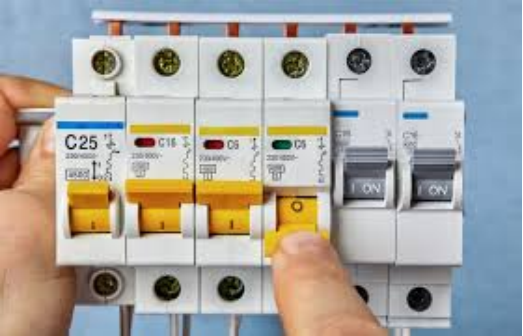
C16, C25, C32, C40, C60, C80, C100, etc., where C represents the tripping current characteristic of C, that is, the tripping current. For example, C20 represents the tripping current of 20a, and the tripping characteristic is the C curve. C20 circuit breakers are generally used for the installation of 3500W water heaters, and C32 circuit breakers are generally used for the installation of 6500w water heaters.
3. When selecting a circuit breaker, you need to consider several factors, including the surge current of each lamp, the operating current, and the overall capacity of the line. Here is a simple step-by-step guide to how to calculate:
A. Determine the surge current of each lamp
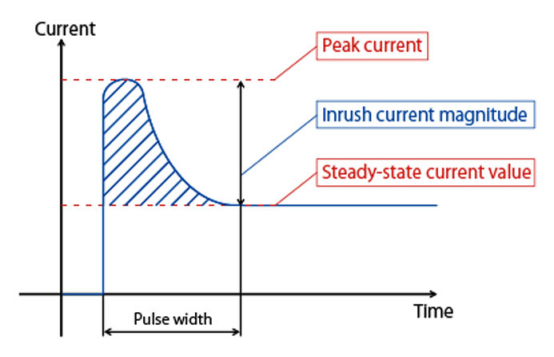
The surge current of each underground lamp is specified in its technical parameters. Typically, the surge current of LED lamps is between 2kV and 6kV, but the actual surge current (in amperes) depends on the specific design. This value can be hundreds of amperes or even higher, and the duration is usually very short (microseconds).
If the surge current of each lamp is marked as 200A (assumed value), then this is the peak current of a single lamp under surge conditions.
B. Calculation of total surge current
In theory, if the surge occurs on all connected lamps at the same time, the surge currents will be superimposed. So, assuming the surge current of each lamp is 200A, when 50 lamps are connected:
Total surge current = 50 *200A = 10,000A
This is only the theoretical total surge current. In practice, due to factors such as line layout and cable length, it may not be completely superimposed.
When the installation environment temperature of the MCB exceeds 30℃ or multiple MCBs are installed side by side, the number of mounted drivers will be reduced and needs to be recalculated.
– Electricians usually consider using type B MCB for home lighting and type C MCB for commercial lighting.
4. When selecting a circuit breaker, in addition to considering the surge current, you should also consider the following factors:
– Rated current: The rated current of the circuit breaker must be greater than the operating current of the system. First calculate the total operating current of 50 lamps during normal operation, and then select a circuit breaker with an appropriate rated current.
– Surge current handling capacity: The short-term surge handling capacity (transient current withstand capacity) of the circuit breaker should be able to meet the total surge current that the system may encounter. Usually, the surge current specification will be marked in the short-term withstand capacity of the product, such as “Icu 10kA”, which means that it can withstand a short-term surge current of 10kA.
“Icu 10kA” refers to the rated ultimate short-circuit breaking capacity of the circuit breaker, also known as the ultimate short-circuit breaking current. This parameter indicates the maximum current that the circuit breaker can safely break in extreme short-circuit conditions. In this example, 10kA means that the circuit breaker can withstand and break a current of 10,000 amperes (10kA) in a short-circuit condition without being damaged.
Detailed explanation:
Icu (Rated Ultimate Short-Circuit Breaking Capacity): This is the maximum current value (peak current) that the circuit breaker can safely cut off when a short circuit occurs, without causing permanent damage to the circuit breaker itself in the process. However, after completing a break under extreme conditions, the circuit breaker may need to be maintained or replaced.
Function:
In actual applications, if a short circuit occurs in the circuit, the current will quickly rise to a very high value. Icu 10kA means that the circuit breaker can disconnect the circuit in time when encountering a short-circuit current of up to 10,000 amperes to prevent overheating of wires, damage to equipment, or fire.
If the surge current of each lamp in the system is high, and surge currents of multiple lamps may occur at the same time, it is recommended to select a surge protection device (SPD) to additionally protect the circuit to disperse the surge current and reduce the pressure on the circuit breaker.
5. Is the total surge current simply superimposed? In practice, the total surge current is not necessarily simply superimposed. The surge current is usually a transient phenomenon, and the surges of different devices may not occur at the same time. In addition, factors such as line layout and wire and cable length will also affect the actual surge current. Therefore, in practical applications, surge protection devices (SPDs) can be installed to prevent damage to equipment or circuit breakers in the system due to transient excessive surge currents.
Conclusion:
– Working current is used to select the rated current of the circuit breaker.
– Surge current is used to select the short-term overcurrent handling capacity (transient surge capacity) of the circuit breaker, or to install appropriate surge protection devices to disperse and suppress surge currents.