Have you ever noticed a faint glow, or "ghost light," in high-end hotels, museums, or theaters after the lights are turned off? This phenomenon, known as afterglow, not only compromises the overall lighting effect but also raises concerns about product quality and energy efficiency. This is the notorious issue associated with traditional non-isolated 0-10V dimming drivers.
What Causes Afterglow in LED Fixtures?
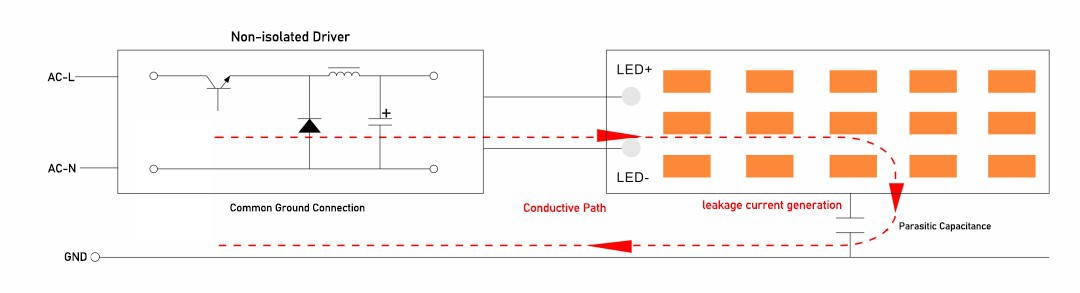
LED fixtures can produce this glow due to parasitic capacitance in the metal core printed circuit boards (MCPCBs) used for heat dissipation. Non-isolated drivers can form leakage current paths through the parasitic capacitance in the fixture, causing the LEDs to glow faintly even after power is turned off.
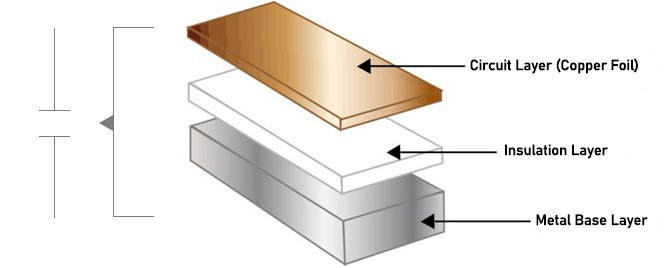
Parasitic Capacitance in the Metal Base Copper-Clad PCB of LED Fixtures
To improve heat dissipation, LED fixtures typically use a metal base copper-clad PCB. This structure, consisting of a circuit layer (copper foil), an insulation layer, and a metal base layer, is a typical flat capacitor structure. As a result, parasitic capacitance is inevitably present in the fixture.
Leakage Current Path Scenarios
The leakage current path forms in the following three scenarios:
Single-phase AC Input for LED Fixtures: When the light is turned off using a switch, if only the neutral wire is controlled, or if the live wire is controlled but the neutral wire still carries current, the leakage current flows.

Two-phase AC Input for LED Fixtures: In some applications, the AC input comes from two live wires of a three-phase system, and when the switch controls only one of the live wires, a leakage current path can form.

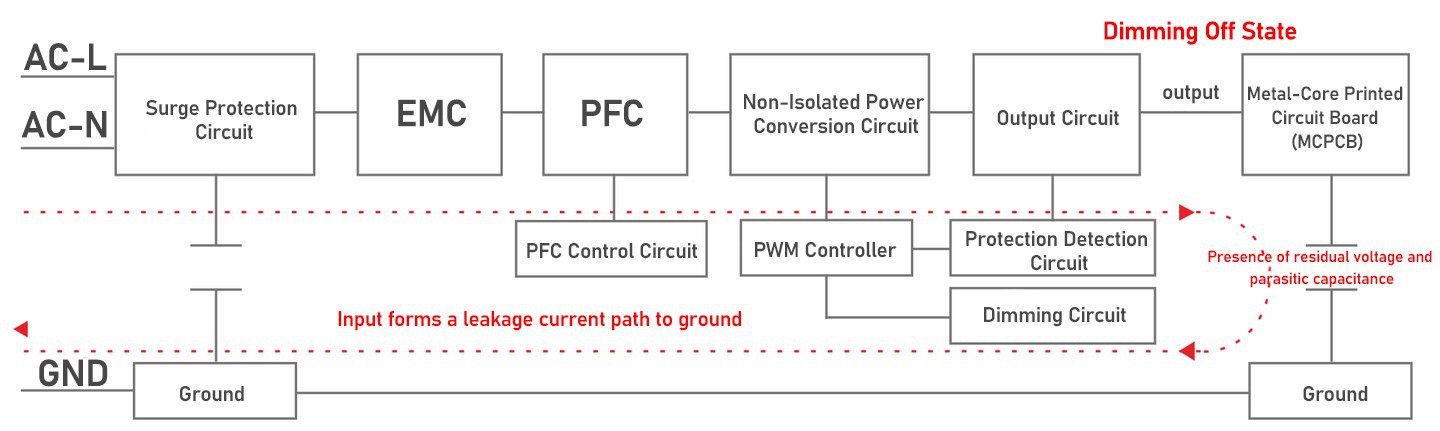
Standby or Dimmed Off State: When the fixture is connected to the AC input line but is in a standby or dimmed-off state.

In these scenarios, the AC input can create a leakage current path through the parasitic capacitance in the metal base copper-clad PCB of the LED fixture.
Low Electroluminescent Current in LED Chips
For lighting applications, the typical operating current of LED chips is above 20mA. However, in darker environments, a microampere-level current passing through the LED chip can produce a visible faint light.
Conditions for Afterglow Formation: Parasitic Capacitance, Electrical Paths, and Low Electroluminescent Current
In the above three scenarios, a weak leakage current, in the microampere range, may pass through the LED chip. This current does not pose a safety risk but is enough to cause the LED to emit light, resulting in afterglow.
The mechanism of afterglow in non-isolated drivers can be illustrated as shown in the diagram below.
Our Solution: Non-Isolated 0-10V Dimmable Driver without Afterglow
✅ Two Voltage Inputs: 120-277V or 200-480Vac, adaptable to global power grid environments.
✅ Precise Constant Current Output: 150-200Vdc, ensuring stable LED light output.
✅ 0-10V Dimming: Flicker-free dimming, enhancing visual comfort.
✅ 12V Auxiliary Power Supply: Compatible with smart modules for intelligent lighting control.
✅ Dim to off without afterglow: Completely shuts off, with no residual light, improving user experience.