
1. Color rendering:
The color rendering of a light source is represented by the symbol Ra. It refers to the degree to which the light source presents the natural primary color of an object. That is, the degree of color fidelity, usually called the “color rendering index”. The larger the value, the higher the color rendering, and the higher the degree of restoration of the color of the object.
Many lighting manufacturers will mark Ra≥90 (R9≥50) on their products. Ra≥90 means that the lamp has a high degree of restoration of R1~R8, good color rendering, and is closer to natural color. R9≥50 means that the lamp can restore the color of red objects very well.
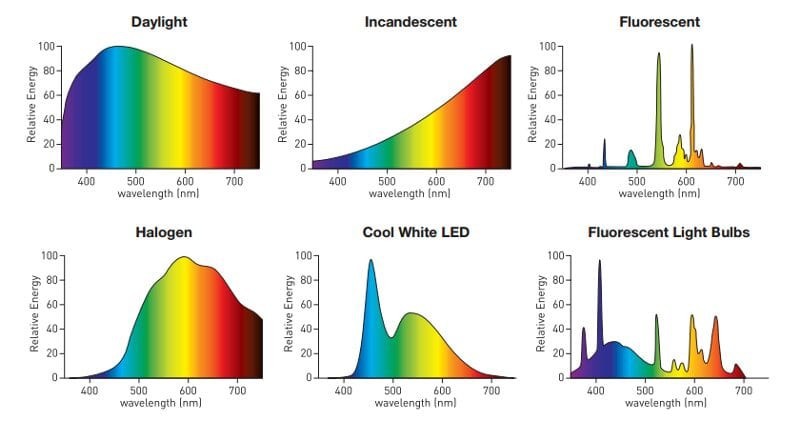
The spectral power distribution of the light source determines the color rendering of the light source. The closer to the spectrum of natural light, the higher the color rendering index
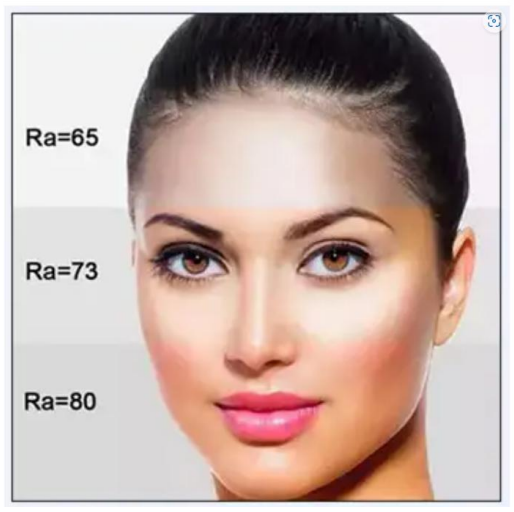
Ra is the average of R1-R8; other values from R9 to R15 are not used to calculate Ra, including R9 “Saturated Red”, R13 “Skin Tone (Light)”, and R15 “Skin Tone (Medium)”, which are difficult to reproduce faithfully.
R9 is an important indicator in high color rendering index lighting because many applications require red light, such as film and video lighting, medical lighting, artistic lighting, etc. However, in general CRI (Ra) calculations, R9 is not included.
2. Factors that Affect Color Rendering Index
Light Source
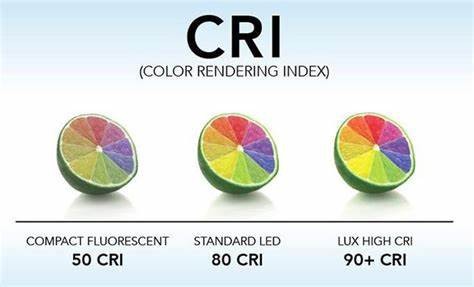
The type of light source plays a key role in determining the color rendering index (CRI). Different lighting technologies, such as LED, fluorescent, incandescent, or halogen, have different spectral distributions that affect how colors appear. For example, LEDs have made significant advances and now offer high CRI values suitable for color-critical applications. It is critical to select a light source with a CRI value that matches the specific needs of a space to ensure accurate color rendering.
Object Material
The color, texture, and reflective properties of a material significantly affect how colors are perceived under different lighting conditions. Materials can absorb, reflect, or transmit light in different ways, which affects color rendering results. Understanding the interaction between materials and light is essential to achieving the desired color rendering, especially in color-critical industries such as fashion, interior design, and art.
Distance and Angle
The distance and angle at which light strikes an object can change color perception. As distance increases, light intensity decreases, which affects color rendering. Similarly, the angle of lighting can create shadows or accentuate textures, affecting color perception. The placement and orientation of lighting fixtures must be considered to achieve optimal color rendering.
3. Benefits of High CRI
Visual Comfort
High color rendering index (CRI) lighting greatly improves visual comfort. It creates a pleasant, natural atmosphere that makes indoor spaces feel more like the outdoors. High CRI lighting minimizes eye fatigue, making it easier to perform tasks that require sharp eyes to discern color. The naturalness and clarity of light, along with high CRI values, enhance visual comfort, which is critical in residential and professional environments.
Improved Aesthetics
High color rendering index lighting brings out the true colors of objects, enhancing the beauty of a space. Whether it’s a living room, a retail store, or an art gallery, high CRI lighting enriches the environment by rendering colors vividly and accurately. It emphasizes beauty, creating an attractive and appealing space. Enhanced color accuracy helps better represent interior design, artwork, and merchandise, making spaces look more attractive and appealing.
Improved Productivity
Quality lighting with high CRI values can improve productivity, especially in work environments. Good color rendering provides better visual clarity, which is critical for tasks that require color accuracy. It helps reduce errors and improves work accuracy and efficiency. High CRI lighting can also improve mood and alertness, further increasing productivity. In design studios, workshops, or any professional environment where color differentiation is critical, high CRI lighting is essential.
4. Disadvantages of Low CRI
Poor Color Accuracy
Lighting with a low color rendering index (CRI) can distort colors, making them appear unnatural or washed out. In residential and commercial settings,
this poor color accuracy can be misleading and unsatisfying. For example, in a retail environment, products may look different under low CRI
lighting, which can lead to unhappy customers.
Strain and Discomfort
Over time, low CRI lighting can cause eye strain and discomfort. Harsh lighting and inaccurate color rendering can make it difficult to focus, especially on tasks that require a keen eye to discern color. This can lead to fatigue and decreased productivity and comfort.
Degraded Work Quality
In industries where color accuracy is critical, low CRI lighting can significantly reduce the quality of work. It impedes the ability to make accurate color
judgments, which is detrimental in fields such as graphic design, painting, photography, and other color-critical tasks.